

HIS PLACE IN THE TRANSFORMATION OF RADIO SHOULD NOT BE FORGOTTEN
Special to the North Coast Times, Jan. 27, 2026
From Franklin McKnight
When the history of radio in Jamaica comes to be written, a lot of attention surely will be placed on that fork in the road, the transformative period in 1990 when IRIE FM came to be born and started its journey to become, today, the most popular station in Jamaica.
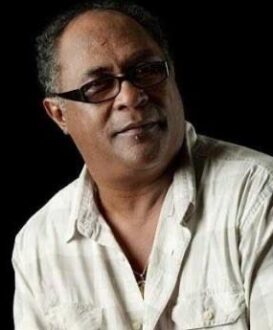
(Bob Clarke)
But the historians better get it right, because many are already failing to recognize that one of the station’s conceptualizers, one of those who put in so much hard work to make that success possible, was Walter Charles Clarke, or Bob Clarke.
Bob died Tuesday morning, January 27, at Port Maria Hospital, St Mary. He was 75.
One of those brave enough to make the point about Bob’s role at Irie is Andrew Clunis, who, in a piece for the Jamaica Times, called Bob a co-founder.
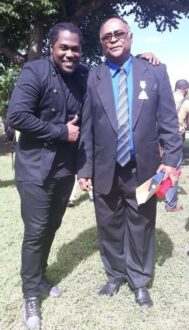
(Sharing the moment after being conferred with the Order of Distinction OD, at King’s House, with son Courick)
Bob was everything to IRIE in the early days and functioned there for the better part of 30 years
He was a presenter, a management executive, a trainer, the voice behind those iconic jingles, such as “a who tun off di raaja”, the man with the ability to carry on a conversation among three people in distinctly different voices. He was the music historian, ethicist, and debater and the man to listen to on a Sunday afternoon. The stories now being told confirm he was all that and more.
Bob’s life and contribution, though, didn’t start and end at Irie.
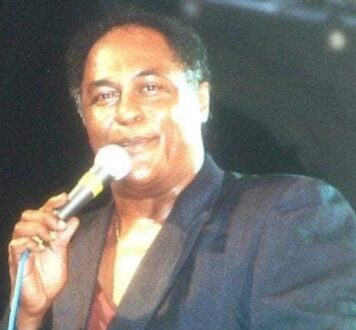
(Comfortable with the mic, always)
Indeed, the day, Monday, he was found unresponsive at home when a daughter called on him to do his usual chore, was the day after he had finished a shift, Sunday evening at the radio station Riddim in Montego Bay, St James. He started there on May 1, 2021. CEO of Mello Group, which includes Riddim Al Robinson, who hosts a music programme at the same time on Sundays, remembers Bob’s last studio action. “He came [into] the Mello studio at approximately 6:15 and shook my hand, his parting words ‘Respect Chief’.”
For years, Bob and Karl Young, ‘Chief” at Irie, argued and haggled over the business of compensation to Bob, the acknowledgement of the lead role he took in getting the station up and running and what recognition he should receive. When Karl Young died, the dreams of any resolution or payment were interred with his bones.
COVID-19 and the workplace rules made matters worse for Bob at Irie. More than two dozen people were laid off at the station. Bob, who had given birth to the station, was cut loose. Then, always the radio man, he joined Riddim.
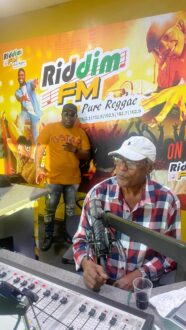
(Bob’s last studio act, Riddim)
Well, not “always the radio man.” Before giving birth to IRIE with Lloyd Stanbury, Clyde McKenzie and others, Bob was a cabaret singer of sorts, a concert emcee, a talent curator and finder.
Businessman Paul Harding, known to his friends as Officer or Jumbo, met Bob in the late 70s at the Mallards Beach Hyatt (part of what is now Moon Palace). Bob was the lead vocalist of the hotel band. “Bob was so real. When he said yes is yes and if he said no is no…what a man,” Harding said.
One of his sons, Courick Clarke, believes Bob was “the real man.” He told the North Coast Times,: “I am very very impressed by how much Daddy instilled in me.” He said Bob Clarke used almost every conversation and every interaction to teach values and living. He remembers when he was about seven years old and stepped on some glass, which cut him. His father said, “You have to watch where you are going. You can’t just go aimlessly. Choose your steps carefully,” He said that stuck with him and has guided his steps. “For every conversation we had, he seemed to take pride in leaving me in a better place than we started.”
Bob had his own serious crash that affected his mobility but not his mood or civility or purpose. He was easy to talk to, loved talking about journalism and ethics and challenged many over the English Language.
Then on Monday morning, he said his last words and died early Tuesday morning. “It’s not anything natural that killed him,” said one of Bob’s colleagues. “He died of a broken heart. It’s not easy to see something you created benefitting so many, and nothing is there for you.”
The post-mortem may well be different. The history of radio should get it right.